 StampVault AI
Sell a printable your customer cuts up - then buys again
Faux postage stamp sheets are printable pages of fake stamps that junk journal and scrapbook buyers print, cut out with scissors and glue down. The page gets used up. So they come back for volume two.
This is the prompt library built for that one product - and thirty finished images so you can see what it makes before you spend a credit.
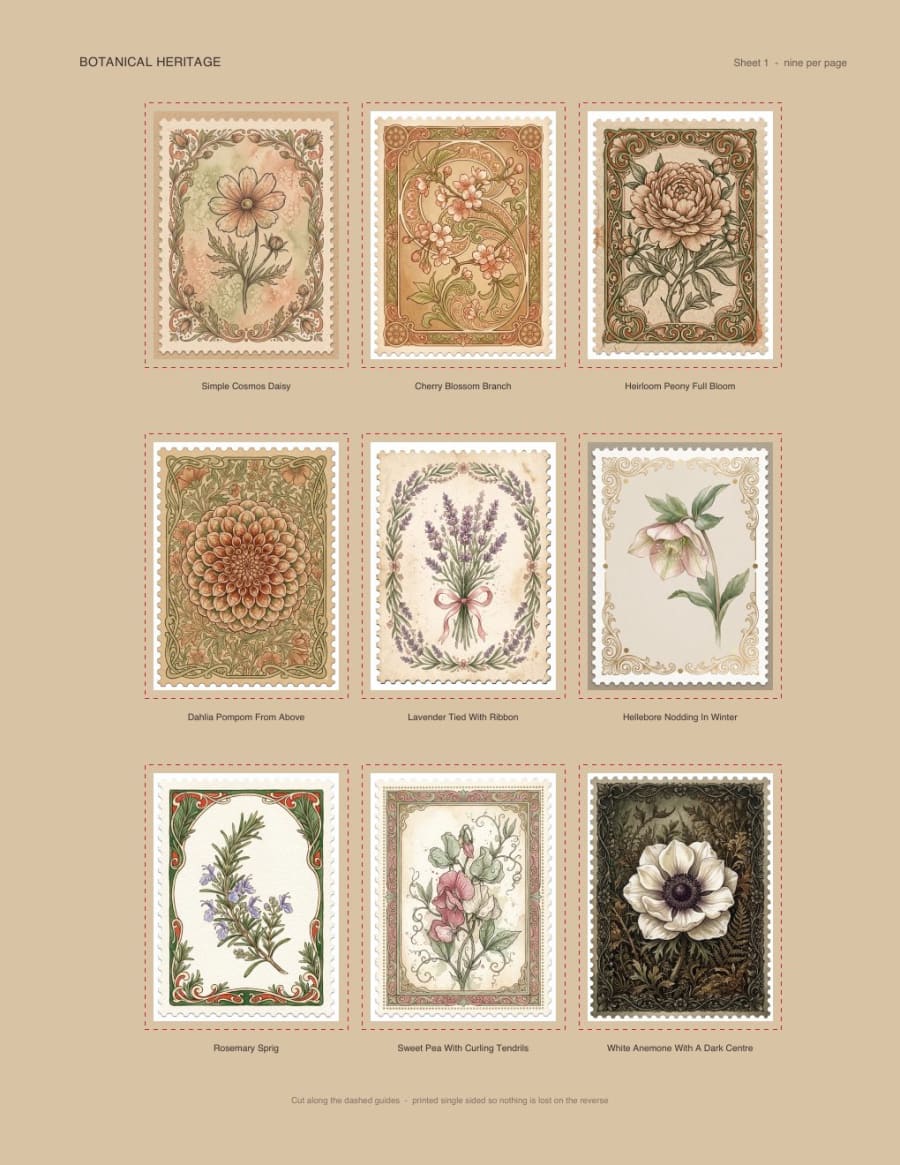
One page from the demo book: nine stamps, real perforated frames, dashed cut guides. Made with prompts from this pack.
$17 → $13.60 when you apply it at checkout
Paste it into the coupon box on the WarriorPlus order form - the discount shows before you pay. Expires 25 August 2026, 23:59 US Eastern, when the launch closes.
Prompt → image → something you can list
You do not need to design anything, and you do not need to already be a publisher. You need one AI image tool and about an hour.
Copy a prompt
Open the kit, filter to one theme, click the copy button for the tool you already pay for. Twelve prompts takes a minute.
Render the stamps
Paste and generate. The perforated edge, the paper, the framing and the no-lettering instruction are already written in.
Lay out and list
Nine to a page, export as PDF, and list it on Etsy or KDP. The 300-keyword file and the category guide are in the download.
A book the buyer is supposed to destroy
Most low-content publishing sells something used once and then shelved. A colouring book is finished when it is coloured. A planner is finished when the year ends.
A sheet of cut-out ephemera is consumed the moment it is used well. That single fact is why the person who buys one book of it buys the next one - and why the same customer is worth returning to with volume two, volume three and a themed box set.
You are not selling a keepsake. You are selling a refill.
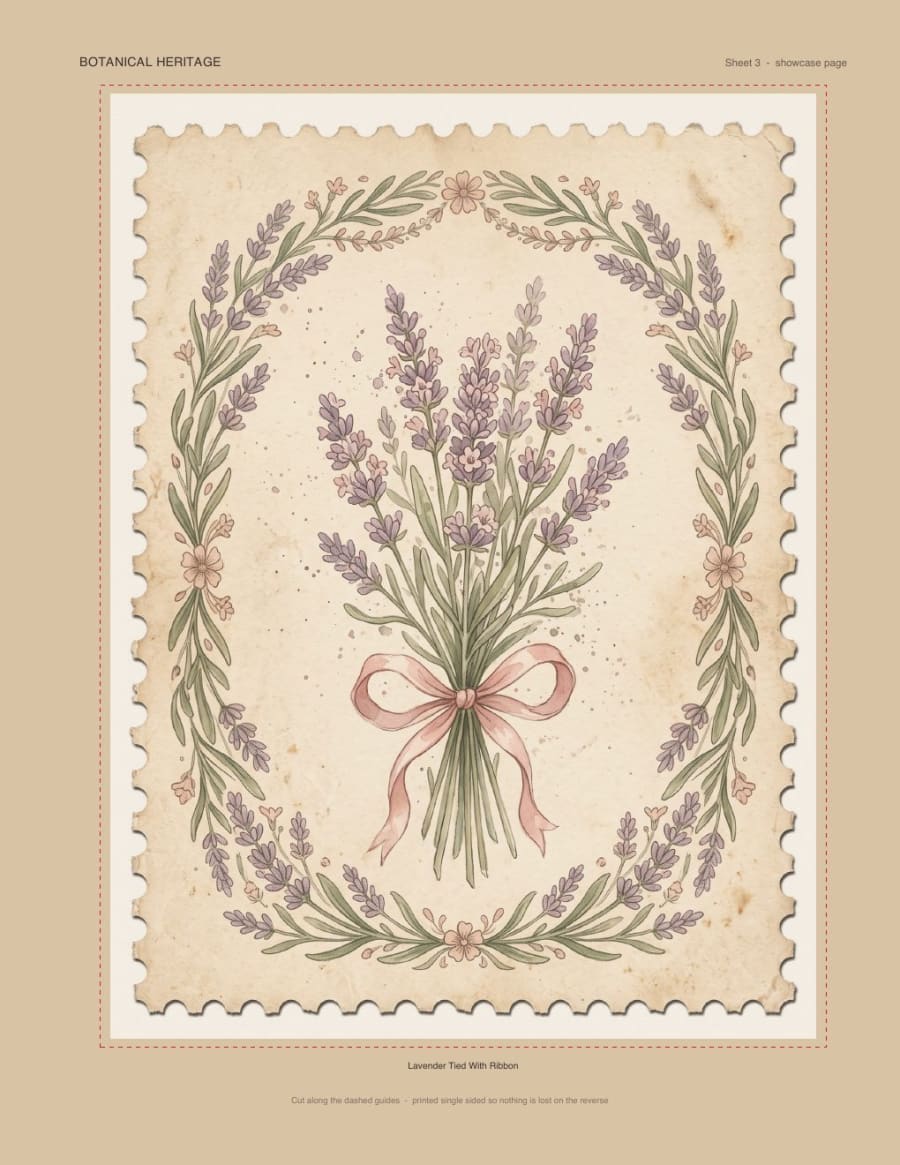
A showcase page from the demo book. Everything on it came out of prompts in this pack.
You do not have to take that on faith. Open Etsy, search two words - faux postage stamps - and look at the sales counts under the shops that keep coming back. Those are other people's shops and other people's numbers, not a promise about yours. They are there to show you the category is real and was not invented by whoever wrote this page.
Thirty finished renders ship inside the download
Prompt packs are hard to judge before you buy, because the thing sold is text and the thing you want is a picture. The honest fix is to include the pictures.
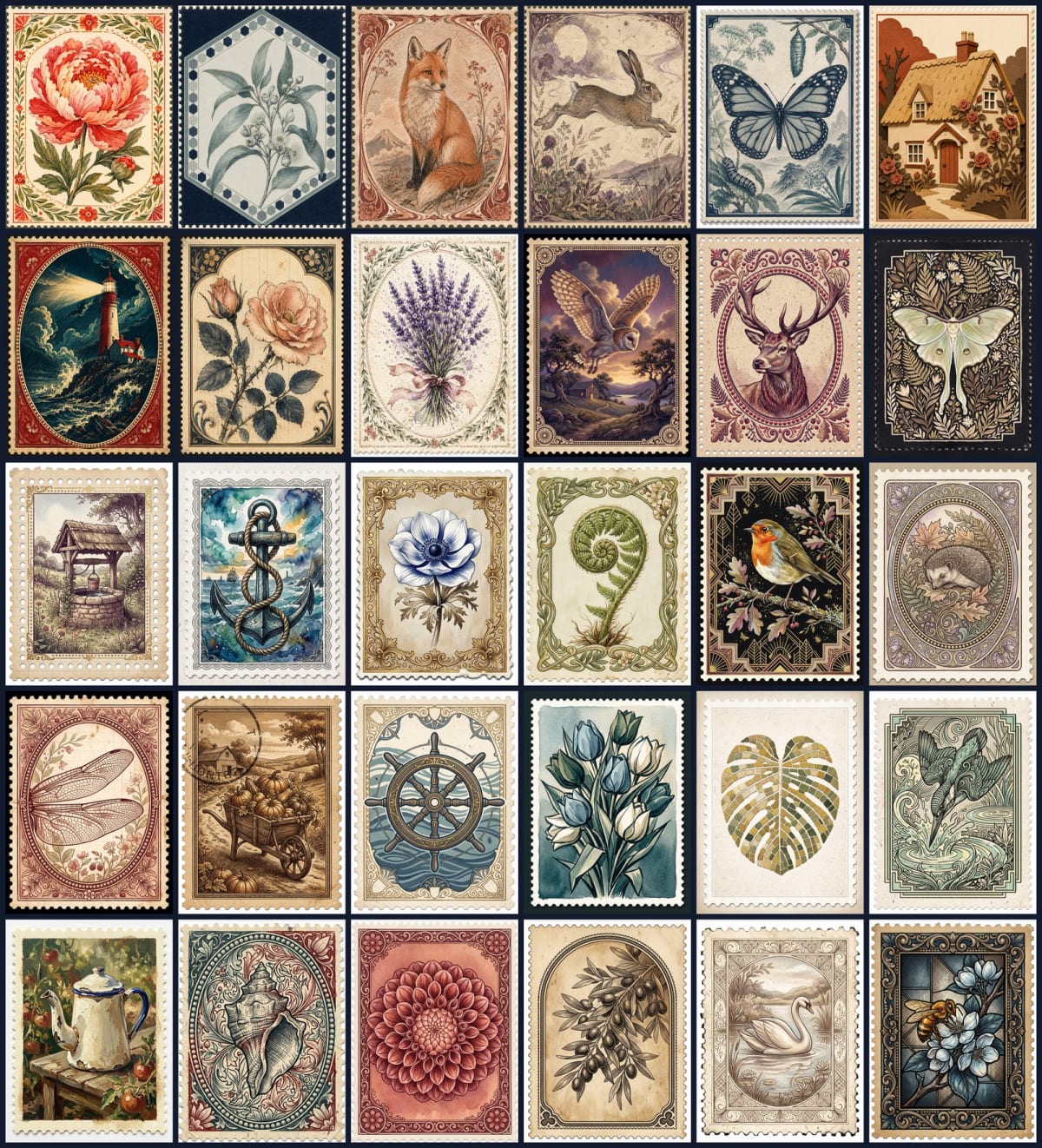
All 30 sample renders are in the folder, each named after the prompt that produced it - so you can look up SV-G0007 in the kit, read the exact words, and see what those words returned. Yours will not be these: nobody else who owns this pack generates the same images, which is the point.
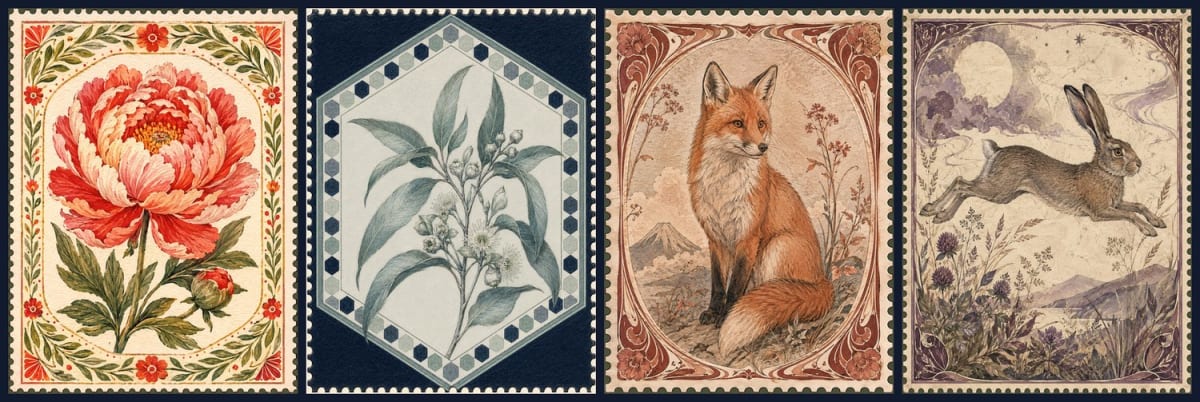
Four of the thirty at working size. Perforated edge intact, no lettering, subject filling the frame.
Ask an AI tool for a stamp and it fails three ways at once
Not one way. Three - and each one costs you differently.
No perforated edge
The punched border is the single cue that makes a rectangle read as a stamp. Ask plainly and you get a straight edge, or a border that looks drawn on rather than punched through. The image is fine. It is just not a stamp.
Invented lettering
Models put text on stamps because real stamps have text. Back comes a country that does not exist, spelled wrong, in a currency nobody uses. Garbled type is the most common reason a print-on-demand interior gets rejected.
It floats in a white square
The subject sits small with wide margins. Drop nine of those on a page and each carries a faint grey halo. On screen you barely see it. On paper it is the difference between a collector album and a photocopy.
346 prompts written for this exact job
Not a general art pack with a stamp theme bolted on. Every line in every prompt is there for a reason connected to printing and selling the result.
Each names the perforation as a real philatelic feature rather than a decorative edge. Each names the paper stock and the medium separately. Each carries a negative instruction blocking text and watermarks. Each is framed so the stamp fills the image with a hairline margin instead of floating in white.
Behind the 346 sit 102 distinct subjects across 7 themes, drawn with 60 mediums and 62 public-domain style references. Each subject carries three or four variants, and no two share both a medium and a reference - so a peony drawn four times gives you four genuinely different stamps, not four near-duplicates with the adjectives shuffled.
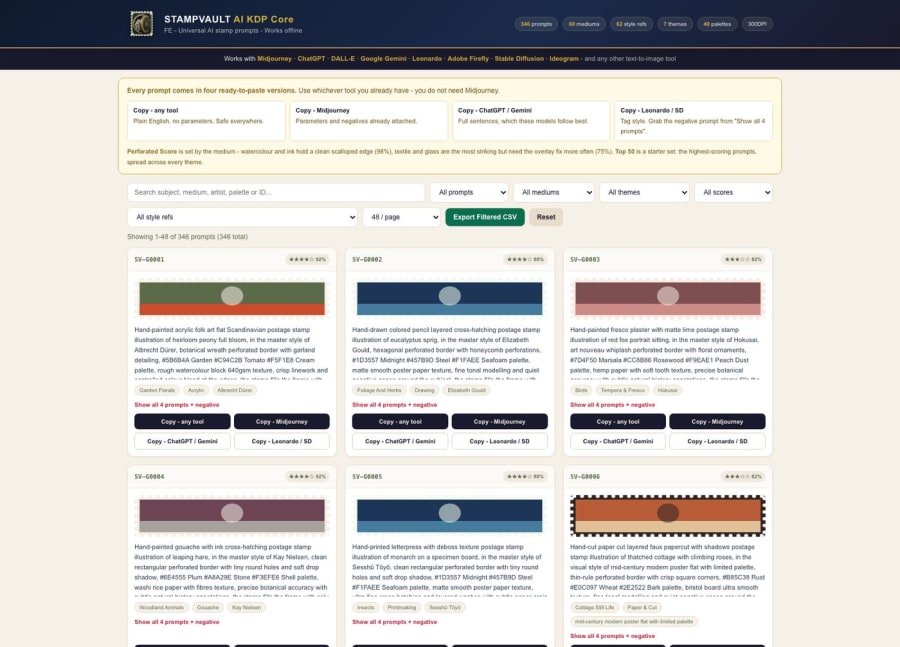
The kit is one HTML file. Opens in any browser, needs no internet, makes no request to any server. Filter by theme, medium, style reference or perforation score, then copy.
Every prompt is written four separate times
Most packs are written for Midjourney and hand you a note saying “adapt for your tool”. Adapting is the work. All 346 exist in four versions, on four buttons - 1,384 ready-to-paste prompts in total.
| Version | Written for | Why it is different |
|---|---|---|
| Universal | Anything | Plain English, no parameters, no syntax that breaks outside one tool. |
| Midjourney | MJ v6 and up | Parameters and the negative list already attached, aspect ratio set. |
| DALL·E / ChatGPT / Gemini | Conversational models | Full natural sentences, which these models follow far better than comma-separated tags. |
| Leonardo / SD | Tag-weighted engines | Tag style, with the negative prompt supplied as its own field. |
If you already pay for one AI image tool, that is the one you use. Free tiers usually work too - with fewer generations, and sometimes lower resolution.
Everything included at $17
| What | Detail |
|---|---|
| 346 prompts | 7 themes, 102 distinct subjects, 60 mediums, 62 public-domain style references. |
| 4 versions of each | Universal, Midjourney, DALL·E/ChatGPT/Gemini, Leonardo/SD - 1,384 ready-to-paste prompts. |
| 30 finished renders | PNG and JPEG, each named after the prompt that made it. |
| The HTML kit | One self-contained file. Search, filter, paginate, copy with one click, export a filtered CSV. |
| CSV, Excel, TXT | The same 346 rows in every format, 15 columns each. |
| Perforation score | Every prompt scored by medium, so you can filter to the ones most likely to punch a clean edge first time. |
| Top 50 flag | Fifty prompts marked as the starter set, spread across all seven themes rather than clustered in one. |
| Commercial licence | Sell the books, sheets and print-on-demand products you make. Keep 100%. |
Four bonuses that fill specific gaps
Each of these was built after the vault was tested on real work, because each was something that turned out to be missing.
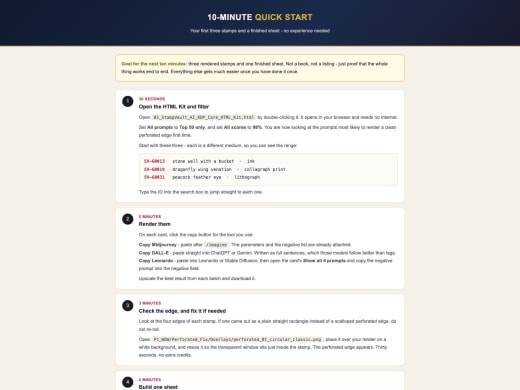
10-Minute Quick Start
The shortest path from opening the folder to your first rendered stamp. Read it once and skip the rest of the documentation.
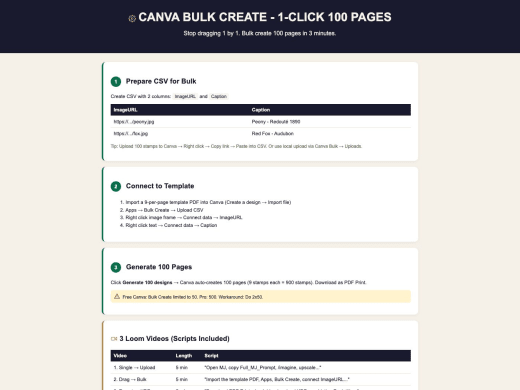
Canva Bulk Create Guide
How to lay out nine stamps a page without placing them one at a time, plus a 100-row bulk CSV with the Top 50 already at the front.
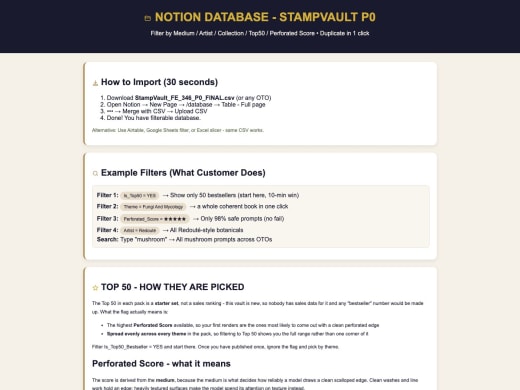
Notion Database Template
For tracking which prompts you have rendered, which book they went into, and which are still unused.
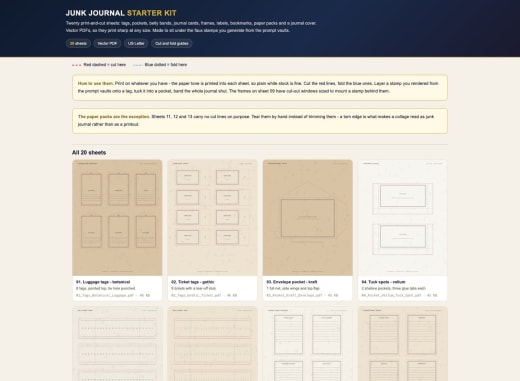
Junk Journal Starter Kit
Twenty print-and-cut sheets - tags, pockets, belly bands, journal cards, frames, labels, bookmarks - to sit under the stamps you make.
There is also a keyword file with 300 checked KDP search terms, and a category guide explaining how category selection actually works now rather than repeating advice that stopped being true two years ago.
In the order it really happens
Filter to one theme
A set that shares a theme reads as curated instead of assembled - and it is one click rather than a decision you keep making.
Set the score to 98%
That surfaces the prompts most likely to punch a clean edge first time. Copy twelve, not nine: you want to drop the two weakest and still fill your sheets.
Paste into your tool
Using the button written for it. No rewriting, no adapting, no learning a second tool.
Lay out nine to a page
Export as PDF Print and list it. Want the sheet templates, cover wraps and pre-written listings done for you? That is the StampEngine upgrade, offered after this - not required by it.
All sales are final, so let's be straight
This is an instantly delivered digital product and cannot be returned once downloaded. That means the honest thing is to tell you now who should skip it, rather than argue about it afterwards.
Skip it if you want finished artwork
No images are sold to you beyond the thirty samples. You generate your own. If you wanted a folder of PNGs to publish directly, this is the wrong product.
Skip it if you have no AI image tool
You need ChatGPT, Gemini, Midjourney, Leonardo or similar. Free tiers usually work. Paid plans are your cost, not included here.
Skip it if nothing will get uploaded
A prompt library only pays off if something ships. If you collect tools rather than publish, save the seventeen dollars.
Buy it if this sounds like you
You have an AI image tool open, you want a printable niche where the customer uses the product up instead of shelving it, and you would rather copy a solved prompt than spend a fortnight solving it.
What you may and may not do
Yes
Generate images from these prompts and sell them. Publish books on KDP. Sell sheets on Etsy, Gumroad or your own shop. Put the images on print-on-demand products. Use them for client work. Keep 100% of everything you earn.
No
Resell, share or give away the prompt files themselves. You are buying a product, not a resale licence. If you want to rebrand and sell the vault as your own, that is the separate PLR tier offered later in this funnel.
On style references. The 62 references are 50 public-domain masters, all of whom died more than seventy years ago, plus 12 generic descriptive styles naming no living artist. No trademarked character, brand or living artist appears anywhere in the library.
On copyright of AI images. Copyright in AI-generated images varies between jurisdictions and is still developing. This purchase gives you rights to the prompts and files supplied here. It cannot determine the copyright status of images you generate - that depends on your local law and your tool's terms. Check your AI tool's commercial-use terms before selling anything made with it.
Questions people actually ask
Do I need Midjourney?
No. Every prompt exists in a version for conversational models like ChatGPT and Gemini, and another for tag-weighted engines like Leonardo and Stable Diffusion. Use whichever you already pay for.
Will these work on my tool's free tier?
Usually yes, with fewer generations and sometimes lower resolution. The prompts do not depend on paid-only features. They depend on the model following a long instruction, which every current mainstream model can do.
Do I need to already know KDP or Etsy?
No, but you do need to be willing to learn the listing side. The download includes a 10-minute quick start, 300 checked KDP keywords and a category guide. It does not include a course, and it will not list the product for you.
What resolution do the images come out at?
That is set by your tool, not by the prompt. Every prompt asks for portrait 3:4 and 300 DPI-ready detail; what you receive depends on the model and plan. For KDP interiors you want at least 300 DPI at your printed size, so check before committing to a trim.
Is this just ChatGPT output dressed up?
The prompt text was written with AI assistance and then edited by hand, which is the honest answer. What it is not is one template with the subject swapped: the taxonomy behind it - 60 mediums, 62 references, 40 palettes, 20 papers, 12 border styles - was assembled so no two variants of a subject share both a medium and a reference.
How is this different from a free prompt list?
A free list gives you a sentence. This gives you a sentence that names the perforation gauge, blocks lettering, sets the framing and arrives in the dialect of your tool - plus thirty rendered examples so you can see before you spend. If a free list does that, use the free list.
How do I use the coupon?
Click the button, then paste STAMP20 into the coupon box on the WarriorPlus order form and apply it. The price drops from $17 to $13.60 before you pay, so you can see it worked. The coupon is for the front end on this page, and it expires when the launch closes on 25 August 2026 at 23:59 US Eastern.
What is the refund policy?
All sales are final. This is an instantly delivered digital product that cannot be returned once downloaded. That is exactly why this page shows you thirty finished renders, names what is not included, and lists who should skip it. Read it, then buy only if what is described is what you want.
Or take everything in one payment
Most people should buy the front end above and stop there. This exists so somebody who already knows they want the whole thing does not have to buy it in six pieces.
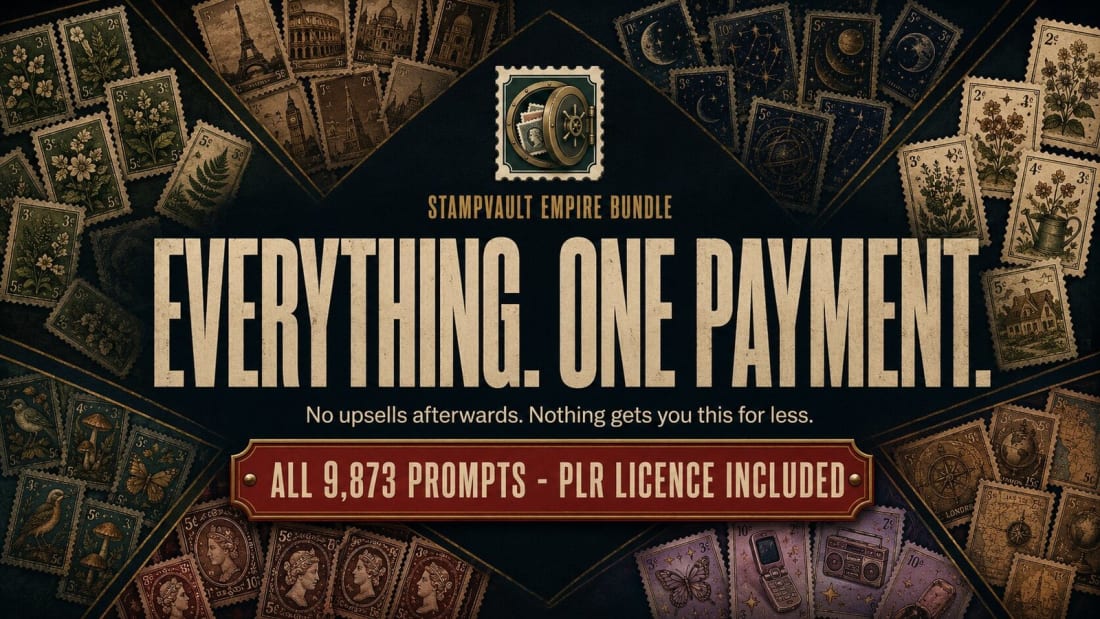
| Included in the bundle |
|---|
| All 9,873 prompts - Core, Botanical, Heritage Travel and Aesthetic Universe |
| StampEngine - 45 sheet templates, 60 KDP cover wrap files, 10 premium cover designs, 150 listings |
| The Etsy kit - 50 sheet templates and 50 complete listings with 13 tags each |
| The white-label funnel kit - rebrandable sales page, VSL script, 30 email swipes |
| PLR licence - rebrand and resell the whole library under your own name, keep 100% |

ThanhDaisy - AiPipPip.net
Hi, I'm ThanhDaisy, the creator behind AiPipPip.net, where I build, review and curate creative digital products. My work focuses on ebooks, colouring books and practical digital resources designed around modern trends, emotional well-being and everyday creativity - and on reviewing digital tools with a clear, honest, user-focused approach, highlighting what truly brings value rather than what merely looks good on the surface.
What is and is not included
Written prompts, thirty sample renders and documentation. No finished artwork beyond those samples is sold to you. You will need your own AI image tool, and most charge a subscription which is not included in this price. All sales are final on this instantly delivered digital product.
Earnings and results disclaimer
The information and resources in this product are for educational and informational purposes only. This product contains prompt ideas designed to help users generate faux postage stamp illustrations using AI tools. Individual results vary depending on the AI tool used, prompt adjustments, creativity and effort. We do not guarantee any specific results, earnings or success. Any examples of possible uses - such as creating stamp sheets or sticker books for Amazon KDP, Etsy or other marketplaces - are provided for illustration only. You are responsible for ensuring your use of AI-generated images complies with the terms and policies of the AI tools and platforms you choose to use.
Privacy policy
We respect your privacy. When you purchase, basic information such as your name, email address and purchase details may be collected through the platform used to process your order. This information is used only to deliver your product, provide support and communicate updates related to the product. We do not sell, rent or share your personal information with third parties. Payment processing and transaction data may also be handled by third-party platforms such as WarriorPlus and their payment partners, whose privacy policies may apply.
Contact
Email support: admin@aipippip.net or aipippipinfo@gmail.com · Product creator: ThanhDaisy9x. We aim to respond within 24 hours.
AI disclosure
This product is a library of written prompts for AI image generators. Sample images shown here were generated with AI from those prompts and are supplied as previews, not as stock artwork licensed for resale. The templates and printable sheets are vector files, not AI images.
StampVault AI - Faux Postage Stamp Books for KDP & Etsy
- by ThanhDaisy, AiPipPip.net
This site is not part of the Facebook, Google or Amazon websites, and is not endorsed by any of
them. Amazon, KDP, Etsy, Midjourney, ChatGPT, Gemini, Leonardo, Firefly and Stable Diffusion are
trademarks of their respective owners and are named here descriptively only.